The Creative Brief Is the Bottleneck: How Smart Teams Are Cutting Asset Turnaround Without Cutting Corners
And here’s the kicker: 80% of marketers genuinely believe they’re nailing their briefs. Only 10% of agencies agree. That’s not a gap. That’s a canyon.
The truth is, most creative delays don’t happen during execution. They happen upstream, in those fuzzy early hours where expectations drift and assumptions go unspoken. The creative brief isn’t just paperwork. It’s the single most expensive bottleneck in your entire production pipeline.
And while 90% of marketers and agencies agree the brief is one of the most valuable tools for quality output, it’s also the most neglected (Simple.io).
Smart teams are waking up to this. They’re mapping exactly where hours evaporate and layering in AI, not as a replacement for creative talent, but as an accelerator that keeps designers firmly in the director’s chair.
Let’s walk through the four stages where time disappears and how a human-in-the-loop AI framework changes the math.
The Four Stages Where Hours Disappear
[If you want the structural breakdown of how those phases connect, Pixflow’s guide on Managing the Lifecycle of a Creative Project lays it out clearly.]
But here’s the uncomfortable truth: four specific choke points in that lifecycle are bleeding your team dry.
Stage 1: The Vague Brief
This is where bad work gets born. A designer receives a brief that reads more like a riddle than a roadmap. They guess. They deliver. And the inevitable response, “This isn’t what I had in mind,” isn’t a design failure. It’s a brief failure.
As like2byte puts it, the unclear brief is the most expensive bottleneck in creative work. A designer from a vague brief delivers work that answers the wrong question entirely. And the numbers back this up. 82% of marketers admit their briefs are modified after submission.
Meanwhile, 30% of clients wish agencies would just ask more questions at the brief stage, according to the DBA “What Clients Think” report. But asking questions takes time nobody feels they have. So the cycle continues: The foundation is cracked before the house is framed.
Stage 2: Misaligned Expectations
Here’s where the perception gap gets expensive. Marketers look at their briefs and see clarity and strategic direction. Agencies look at the same briefs and see confusion.
The BetterBriefs Project quantified this in stark terms: 78% of marketers believe their briefs are clearly written and strategically sound. Only 5%, yes, five percent, of agencies agree. There is a 70-point perception gap between marketers and agencies on brief clarity.
Can you imagine any other business process where the two parties see things so differently and nobody calls timeout?
The downstream impact is brutal. Simple.io found that 30% of agency wasted time comes directly from poor client briefing, and 43% of agencies report significant hours lost to rebriefing. Nobody’s doing creative work yet. They’re just trying to figure out what they’re supposed to be making.
Stage 3: Feedback Chaos
So your team finally produces something. Now comes the approval gauntlet, and it’s gotten measurably worse over time.
The BetterIdeas Project studied this in 2025 and found the average creative idea now takes five rounds of development to get signed off. In 2007, it took three rounds. We’re spending more time circling than creating.
Why? Because 70% of agencies say clients don’t give clear, constructive feedback. And 89% of agencies, along with 84% of marketers themselves, acknowledge that personal opinion plays an outsized role in creative decisions. Gut feelings dressed up as strategy.
The approval infrastructure is broken, too. Only 23% of agencies and 56% of marketers think the current approval process works well. Just 43% of agencies and 62% of marketers think the right people sign off on creative ideas. When the wrong voices weigh in at the wrong time with the wrong kind of feedback, you get death by a thousand revisions.
Adspire reports that agencies spend 40% of their creative time on approval chaos rather than actual creative work. And HubSpot found that 73% of content teams cite poor workflow processes as their biggest productivity challenge overall.
Stage 4: Repetitive Production Grind
But let’s say the brief was solid, expectations aligned, and feedback clear. The work is approved. Surely now things hum along smoothly?
Not really. Because even with a green light, designers get buried in non-creative grunt work. Monotype surveyed over a thousand creative professionals and found that 57% of teams spend more than a quarter of their time on tasks that have nothing to do with actual designing, font management, asset wrangling, compliance checks, and workflow bottlenecks. That’s a full day every week lost to administrivia.
Adobe’s State of Creativity Report paints a similar picture: 44% of creatives burn half their week on repetitive design tasks. And Mediawide found that marketing professionals feel stressed by tight deadlines and repetitive work, almost always rooted in manual processes nobody’s had time to automate.
This is where AI stops being a buzzword and starts being a strategy. Not to replace the creative spark, but to clear away the debris that smothers it.
A Human-in-the-Loop AI Framework for Creative Teams
We’re already seeing this play out in fields like motion design, where tools now automate the drudgery, rotoscoping, object tracking, and color correction so artists can focus on creative decisions. The technology absorbs the repetitive production grind, and the human handles the storytelling.
The same logic applies across all creative disciplines. The Gutenberg describes the framework clearly: humans remain responsible for strategy, final creative direction, and approvals. AI assists with organizing research, drafting early versions, suggesting variations, and flagging brand inconsistencies. You’re not handing over the keys. You’re getting a second pair of hands.
Fabcomlive frames it as the designer evolving into a director role, using AI for volume tasks like resizing and draft generation while making all final creative direction calls, curating outputs, and training AI tools on brand guidelines. The machine generates options. The human chooses, refines, and owns the result.
This is exactly where Genspark’s design tool fits into the workflow. It’s an all-in-one AI workspace that integrates multiple models, GPT, Claude, and Gemini, into a unified platform. Its AI Designer takes text prompts and produces three variations per prompt, spanning social posts, posters, branding mockups, and flyers.
You’re not getting a finished masterpiece. You’re getting raw visual material, a starting point that designers can grab, reshape, and polish. It’s not about replacing the creative process. It’s about compressing the early iteration grind.
The numbers back this up. Monotype found that organizations with structured creative ops workflows reclaim up to 35% of creative time. And 62% of orgs using AI in creative operations report boosts in both efficiency and creativity, not one at the expense of the other.
Adobe’s research reinforces the appetite: more than 70% of creatives believe generative AI could lead to new opportunities for creativity by freeing up time for strategic and high-level tasks, the work they actually want to do.
Teams using centralized collaboration tools report 31% faster turnarounds, 27% fewer review rounds, and 25% fewer revisions. Better tools plus better processes tackle the upstream bottleneck at its source.
Getting Back to Brief-First
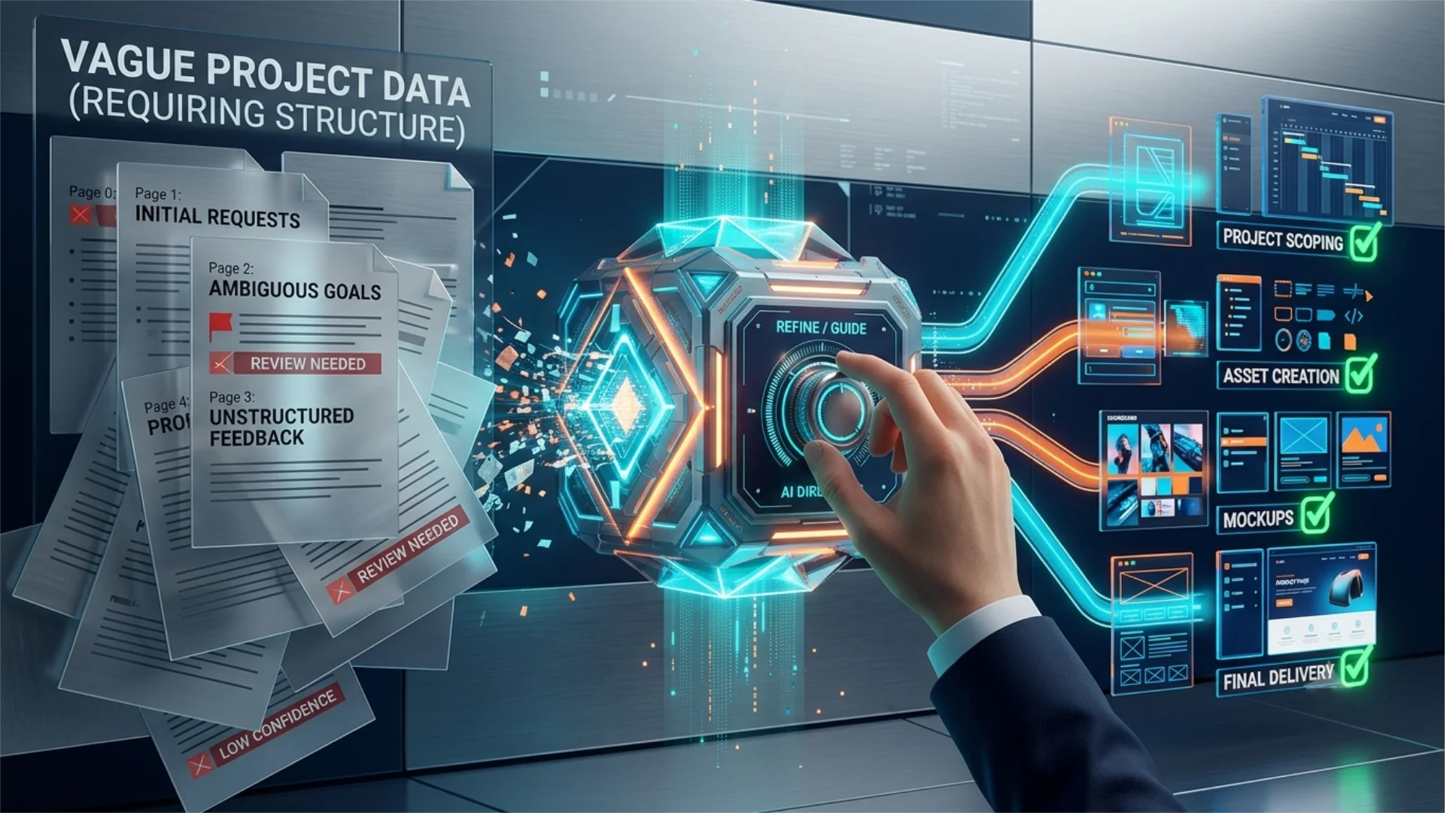
The four stages map exactly where a human-in-the-loop AI approach can intervene: visual probes to surface misalignment, tangible variants to structure feedback, and automation to clear the production grind.
But none of it works unless designers remain the directors, the ones calling shots, curating outputs, and guarding the brand voice.
Here’s your action plan: audit your own briefing-to-first-draft pathway. Measure where hours are actually evaporating. Then layer in AI tools like Genspark to generate raw material, not final art. Use them to get to the interesting decisions faster.
Adobe’s 2024 data shows 83% of C-suite decision-makers noting workload changes, with three in four planning to invest in productivity tools. The smart teams are already doing this. They’re not waiting for AI to replace their creatives. They’re using it to give their creatives back the time that poor process stole.
Stop losing hours upstream. Put the brief back in focus, and let AI handle the heavy lifting under creative direction. That’s how you cut turnaround without cutting corners.
Disclaimer : If you buy something through our links, we may earn an affiliate commission or have a sponsored relationship with the brand, at no cost to you. We recommend only products we genuinely like. Thank you so much.
Blog Label:



Write for us
Publish a Guest Post on Pixflow
Pixflow welcomes guest posts from brands, agencies, and fellow creators who want to contribute genuinely useful content.
Fill the Form ✏