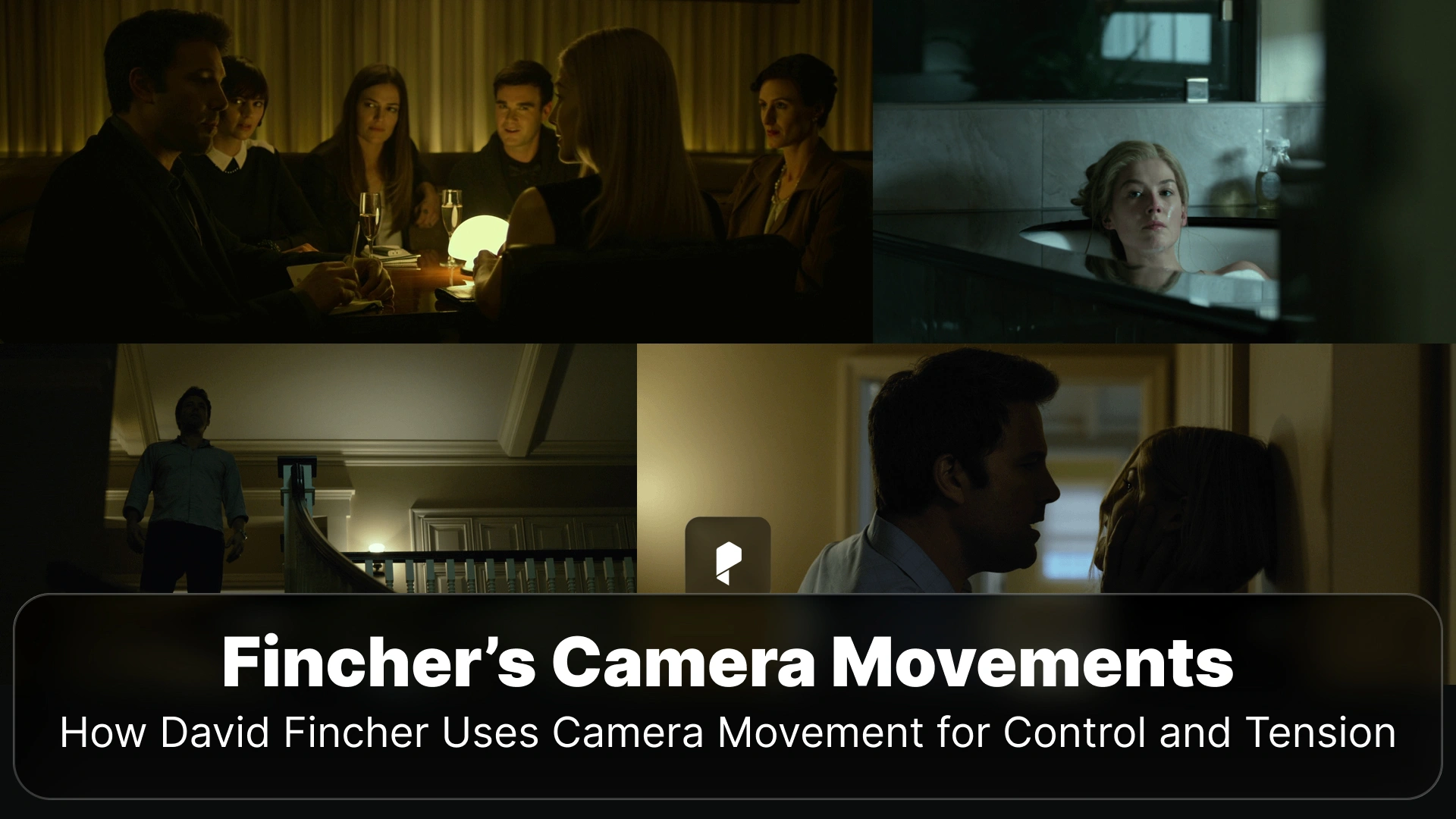
How David Fincher Uses Camera Movement for Control and Tension
Here’s the thing: that feeling isn’t an accident, and it isn’t just lighting or score. In most cases, it’s the camera itself doing the work – moving in ways so deliberate and restrained that your subconscious picks up the signal long before your conscious mind does.
Fincher is, without a doubt, one of cinema’s most precise visual architects. Every camera move in his films is a choice, a statement, a psychological instrument. In this breakdown, we’re going deep into how he uses camera movement to establish control, manufacture tension, and keep audiences permanently off-balance – even when nothing on screen seems to justify that feeling.
The Fincher Philosophy – The Camera as an Authorial Voice
His background in commercials and music videos is crucial here. That world is unforgiving: you have 30 seconds to create a mood, establish a world, and make an emotional impact. You learn fast that every frame has to pull its weight. By the time Fincher made Se7en in 1995, he had already internalized the idea that the camera’s behavior is as expressive as any line of dialogue.
What separates Fincher from many of his peers is his hostility toward the accidental. He’s famously talked about removing “happy accidents” from his sets – those spontaneous, imperfect moments that other directors might embrace. For Fincher, control is the point. The camera doesn’t wander or discover; it already knows where it’s going, and that sense of inevitability is exactly what makes his films feel so suffocating.
The result is a visual language built on restraint: moves that are measured in inches, not feet; pans so slow they’re almost imperceptible; push-ins that you feel in your chest before you register them with your eyes.
Slow, Imperceptible Dolly Moves – Creating Dread Without the Audience Noticing
In Se7en, watch any extended dialogue scene between Somerset and Mills. The camera is almost always inching forward. Not dramatically – just a quiet, relentless creep toward the characters. The effect is claustrophobic. Without consciously registering the movement, audiences feel the walls closing in, the situation growing more inevitable and inescapable.
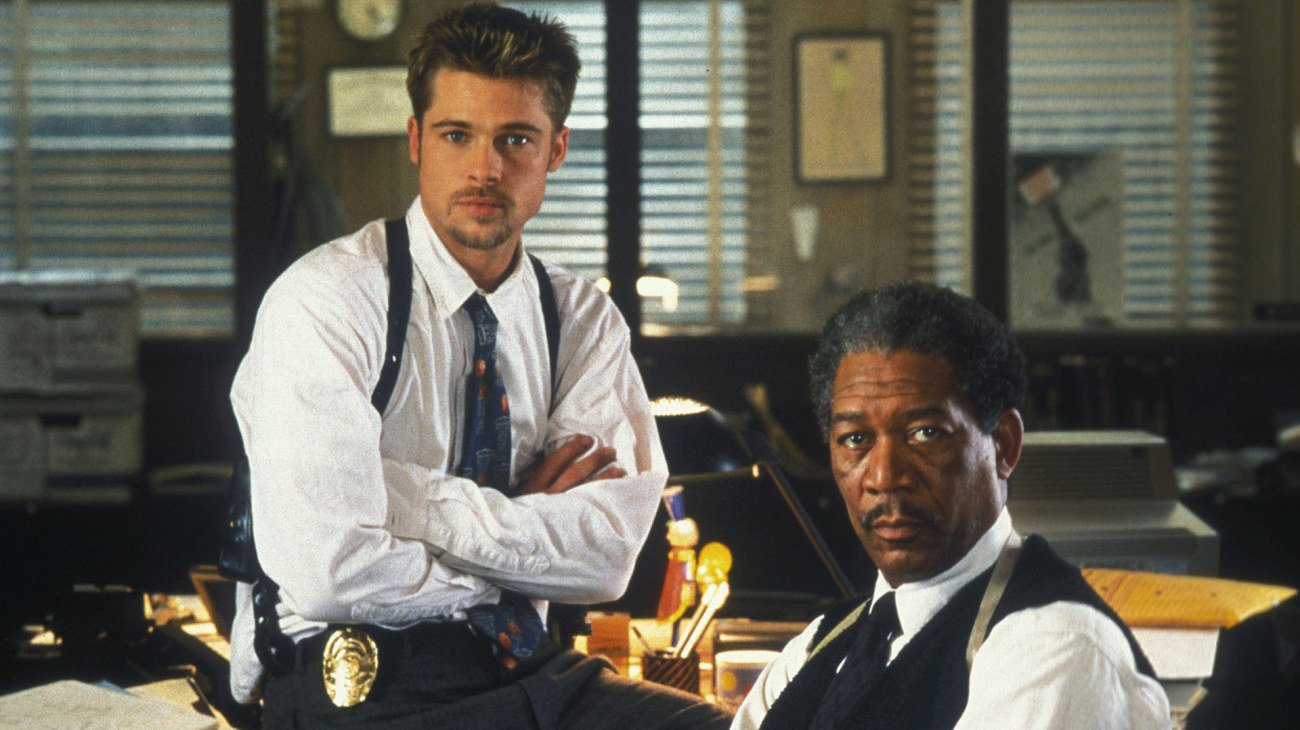
In Se7en, watch any extended dialogue scene between Somerset and Mills. The camera is almost always inching forward. Not dramatically – just a quiet, relentless creep toward the characters. The effect is claustrophobic. Without consciously registering the movement, audiences feel the walls closing in, the situation growing more inevitable and inescapable.
Zodiac takes this even further. Set largely in ordinary spaces – newsrooms, diners, suburban homes – the film should feel mundane. But Fincher’s slow camera drifts turn every frame into a source of low-grade anxiety. You’re watching two journalists eat lunch, and yet something feels profoundly wrong. That’s the drift doing its job.
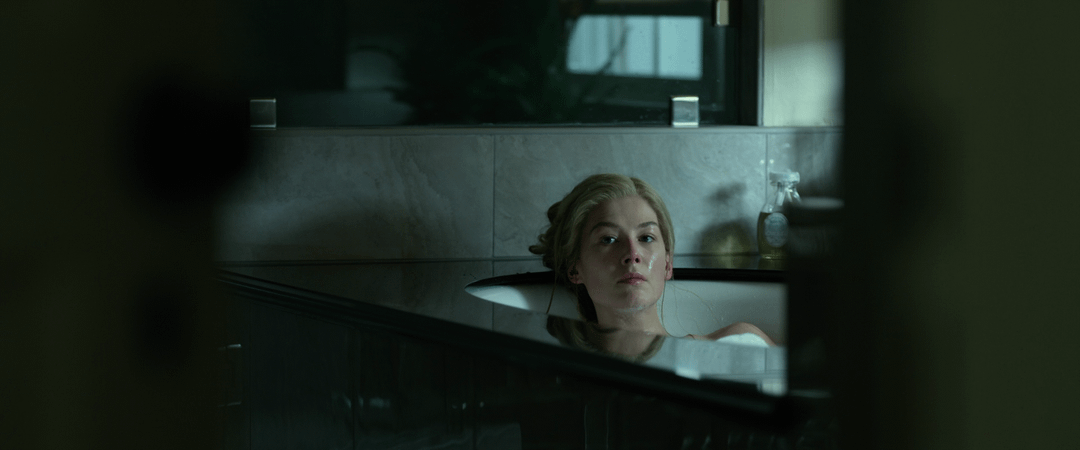
Gone Girl applies the same logic to domestic space. The Flynn house should feel comfortable and familiar, but those creeping moves make every room feel like it’s concealing something. The camera moves the way suspicion moves – slowly, almost imperceptibly, until you can’t ignore it anymore.
The technical discipline required here is significant. These moves run at speeds of a fraction of an inch per second. Any mechanical imperfection or inconsistency would destroy the effect. This is why Fincher obsesses over motion control equipment – and why he shoots so many takes.
The Motivated Push-In – Punctuating Revelation and Power
In The Social Network, the deposition scenes are master classes in this. Each time Zuckerberg lands a particularly cutting remark or gains intellectual ground over his questioners, the camera moves in. It’s subtle, but the effect is unmistakable: we’re being pushed closer to this person at the exact moment they assert dominance. The camera is endorsing his aggression even as the story remains morally ambiguous about it.
Fight Club uses the same logic for Tyler Durden. Every time Norton’s character surrenders another inch of his identity, every time Tyler escalates his rhetoric and wins another convert, the camera pushes in to mark the victory. It’s almost rhythmic – like a heartbeat synchronized to the film’s ideological escalation.
This is also where you see what Fincher deliberately avoids: the zoom. A zoom feels mechanical, obvious, a little theatrical. Physically moving the camera changes the perspective in a way a zoom cannot – the spatial relationship between objects in the frame shifts, depth changes, the world itself feels like it’s pressing in. Fincher knows the difference, and he uses it.
The God-Like Aerial and Crane Move – Surveillance and Inevitability
The opening of Se7en establishes this immediately. The city isn’t just a setting; it’s an organism with its own moral weather, and the descending aerial move frames it as something our characters are being lowered into rather than choosing to inhabit. Somerset and Mills don’t live in this city so much as they’re trapped in it.
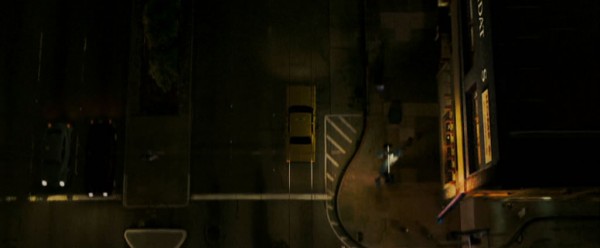
Zodiac returns to this repeatedly. After murder scenes, Fincher often pulls back to an overhead view – a quiet, devastating move that places the victim within the indifferent geography of California suburbia. There’s no judgment in the frame, no horror-movie expressionism. Just a cold aerial perspective that reminds us how alone these people were, and how little the landscape noticed.
In Mindhunter, the institutional overhead shots serve a related purpose. When we look down on Holden Ford navigating the corridors of the FBI, the perspective communicates bureaucratic powerlessness in a way that no amount of dialogue could match. He’s a figure in a system, and the system doesn’t care about him.
These moves share a common theme: a universe that operates by its own logic, indifferent to human suffering. Fincher’s camera, in these moments, isn’t empathetic – it’s omniscient. And omniscience, in his films, is never comforting.
The Tracking Shot as Inevitability – Following Characters to Their Doom
In Fight Club, the tracking shots through the narrator’s apartment don’t feel like exploration – they feel like surveillance. The camera knows this space completely, cataloguing its IKEA-catalogue contents with a detachment that reads as judgment. We’re not discovering the apartment; we’re being shown evidence.
In The Game, tracking shots follow Michael Douglas’s character through increasingly hostile environments with a relentlessness that mirrors the film’s paranoid logic. Wherever he goes, the camera goes – not out of interest, but out of inevitability. He can’t leave the frame because he can’t escape the situation.
This is where Fincher’s preference for motion control becomes relevant again. Precise, repeatable tracking moves reinforce the sense that these paths are predetermined – that the camera has run this route before and will run it again. There’s nothing spontaneous about being followed by a Fincher camera. That’s very much the point.
What Fincher Almost Never Does – and Why That Matters
Handheld camera is the big one. In an era where shaky-cam became a shorthand for urgency and authenticity – from Paul Greengrass’s Bourne films to Inarritu’s fractured dramas – Fincher has been almost completely unmoved. His position, expressed in various interviews, is essentially that handheld “emotional” camera work is a way of telling the audience how to feel rather than letting the scene generate that feeling. It’s a cheat. He’d rather earn the emotion through composition and precision.
Unmotivated reframes are equally absent. In a Fincher film, if the camera moves, there is a reason – a psychological beat being marked, a power shift being registered, a revelation being punctuated. Cameras don’t drift out of boredom or restlessness. Every adjustment is intentional.
And then there’s stillness. When Fincher locks the camera completely – and he does, frequently – it carries enormous weight. A static frame in a Fincher film isn’t neutral; it’s a choice as loaded as any movement. Often it signals that there’s nowhere left to go: for the character, for the scene, for any hope of resolution. The stillness is the tension.
The Technical Infrastructure of Control
Motion control rigs – systems that allow camera moves to be programmed and perfectly repeated – are central to Fincher’s workflow. The ability to run the same move across 40 takes without variation isn’t just efficiency; it’s philosophy. It means the camera’s behavior is never subject to human inconsistency. It means he can isolate the perfect performance against a perfectly controlled visual backdrop.
His long collaborations with cinematographers Jeff Cronenweth (Fight Club, The Social Network, Gone Girl) and Erik Messerschmidt (Mank, The Killer) have been built on a shared grammar of movement. These aren’t directors of photography who impose their own visual instincts – they’re fluent interpreters of Fincher’s visual language, able to execute it with the consistency his work demands.
The move to digital filmmaking was, for Fincher, partly about this control. Shooting on RED and later ALEXA systems gave him finer latitude to adjust movement parameters in post, to push exposure, to achieve the controlled, slightly clinical look that matches his camera’s behavioral coldness. The image and the movement work together as a unified system.
The result of all this infrastructure is something rare: a director whose visual style is so consistent and so deliberate that you can identify a Fincher shot without being told who made it. That’s not just craft. That’s a fully realized cinematic language.
Conclusion
Understanding that grammar doesn’t just help you appreciate his films more deeply (though it absolutely does that). It makes you a more intentional creator. Every time you set up a shot, you’re making a series of choices that will either communicate something specific or communicate nothing in particular. Kubrick always chose the former.
Next time you watch The Shining or 2001, try watching with the sound off for a few minutes. Just look at the geometry. You’ll see the film inside the film – the one Kubrick was composing frame by frame, long before a single line of dialogue was spoken.
Disclaimer : If you buy something through our links, we may earn an affiliate commission or have a sponsored relationship with the brand, at no cost to you. We recommend only products we genuinely like. Thank you so much.
Blog Label:

Write for us
Publish a Guest Post on Pixflow
Pixflow welcomes guest posts from brands, agencies, and fellow creators who want to contribute genuinely useful content.
Fill the Form ✏