How to Review AI Video Scripts Before Recording Voiceovers

- Start With the Facts
- Read It Out Loud First
- Match the Tone to the Message
- Trim the Repetition
- Check the Pacing
- Smooth Out the Transitions
- Watch for Awkward Words and Jargon
- Keep the Structure Tight
- Think About Who's Listening
- Confirm the Script Fits the Visuals
- Get a Second Set of Eyes
- Save Time for a Final Pass
- Listen for Robotic Phrasing
- Double-Check Numbers, Dates, and Abbreviations
- Review Claims for Accuracy and Compliance
- Final Thoughts
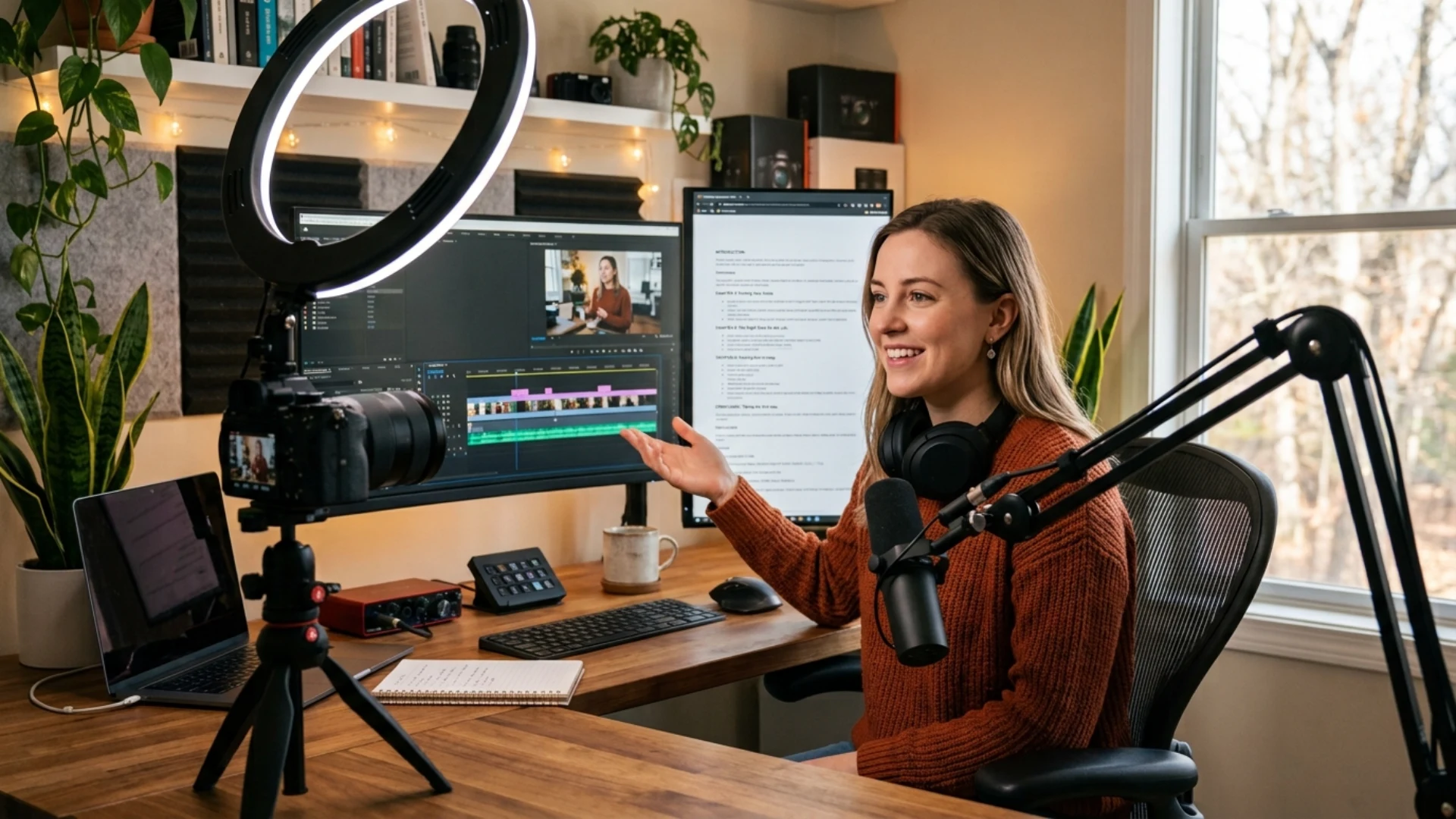
Although an AI-written video script may sound nice on the surface, its wording may be clumsy, full of mistakes, or lack proper tempo. Reading the document first can prevent problems afterward.
If the script is not reviewed thoroughly, mistakes made during recording might result in stopping the session many times.
This guide covers habits to build before recording so your voiceover sounds polished, and natural.
Start With the Facts
Run the script through a free AI checker to highlight the necessary mistakes, redundancy, and awkward phrases prior to the commencement of recording.
This will safeguard you as a professional in front of your clients. Remember that the AI checking service should just act as a preliminary filter, rather than the ultimate solution.
A human being should still go through the names, figures, and statements manually. However, once you establish that the information is accurate, it is just a simple matter of making other checks.
Read It Out Loud First
Reading scripts out loud in the recording room uncovers various twists and problems, like continuous sentences and awkward cadence.
This practice digs problems out in their early stages when fixing them does not cost much. Make a note of the sentences where you stumble no less than two times. This helps you plan better scripts before editing.
If it takes a voice actor more than two tries to deliver one sentence, it is necessary to be rewritten immediately.
Match the Tone to the Message
It is important to check for consistency of voice in the text, taking notice of sudden changes of tone from informal to formal.
Tone inconsistency makes it difficult to understand the text and complicates the process of directing the performer.
Correcting tone inconsistencies before recording makes the finished text cohesive and provides the voice performer with a clear role to perform.
Trim the Repetition
Repetition causes unnecessary breaks in the narration since the speaker must think of variations of their tone for the repeated ideas. By removing repetitions, you are tightening the script and providing the narrator with clearer material.
Check the Pacing
On the other hand, using too many short sentences makes the speech disjointed and too abrupt. Test the timing of your script by reading it out loud while timing it with a stopwatch.
Compare the time taken to deliver the different sections of the script according to the visuals used in your video. If a section takes a longer time, review and eliminate any unnecessary parts. Make sure to leave several pauses at the end of each idea expressed.
Smooth Out the Transitions
When reading a screenplay, be sure that each thought is a direct follow-up to the previous one. When required, add a thoughtful connecting expression where you need it so that it does not seem groundbreaking.
Fluid transition is what makes the voiceover sound like a continuous statement rather than a plain enumeration of facts. Often, such minor modifications are even more effective than any modifications made to sentences.
Watch for Awkward Words and Jargon
Make sure to read each sentence carefully and listen for anything that seems too rigid or uncomfortable to pronounce. Whenever possible, use simpler terms instead of difficult jargon.
In cases where it is necessary to use a technical phrase, make sure to include a clear explanation nearby so the listeners won’t be confused. A text that is easy to read may not, in fact, result in straightforward speech, and this phenomenon is a common surprise during the recording process.
Keep the Structure Tight
Check if the script has followed a clear structure from beginning to end, with the opening providing an expectation, a body delivering it, and a closing bringing everything together without repeating the previous content.
The AI-generated drafts may often conceal the main idea somewhere in the middle or restate the opening idea without any new addition in the ending.
Therefore, it is necessary to arrange the components in such a way that the most precise and impressive thoughts weigh the most. This way, the voice artist will have to deal with each section having a clear function.
Think About Who’s Listening
Ask yourself if the tone and level of detail are appropriate for this audience. For example, a script with heavy explanations would not be appropriate for a relaxed audience.
Similarly, apply the right vocabulary in the right amount of complexity to make a simple script appealing to a professional audience.
This check allows one to see if there are parts to be shortened and other sections to be developed more fully so that the text does not give an impression of being meant for nobody.
Confirm the Script Fits the Visuals
It is advisable to go through the script while working on the storyboard or the video-making process in order to confirm that every line corresponds with the visuals.
For example, if a narrator provides some information about some particular feature, he or she shouldn’t still be discussing it but rather talk about something new.
In case there is no video yet, one should make sure to note important time points to help the editing crew avoid cutting mistakes.
Get a Second Set of Eyes
When you have a different set of eyes on your writing, they will notice confusing statements that you would have ignored. You can ask them to underline any phrases that are confusing to them.
You don’t have to have an elaborate formal review. Even a quick five-minute check will catch things that you had missed after hours of work.
Save Time for a Final Pass
This last read-through highlights mistakes such as typos, improper punctuation, or reminders from the draft. Also, check whether your draft fits the running time of the video and the corresponding on-screen text.
Taking a break before finalizing your work is essential in order to find issues that could have been missed during a tight editing session.
Listen for Robotic Phrasing
Look for unclear language. If you have a sentence that can be used in an unrelated video, spice it up. Generic expressions must be changed to concrete brand properties that give the narrator something to perform. This method of editing makes the final voiceover much more human and unique.
Double-Check Numbers, Dates, and Abbreviations
Abbreviations pose similar difficulties. A word that appears easily on paper doesn’t have a spoken version, thus creating confusion about what it means.
When it comes to acronyms with no predefined way of saying them, it’s very important that they are pronounced clearly.
Review Claims for Accuracy and Compliance
When generated with the help of AI, some statements promise too much by using extreme phrases like ‘always’ and ‘guaranteed,’ having no understanding of the legal responsibility behind that.
It is also necessary to highlight everything that appears to be more of a claim rather than a description, making sure it’s justified with proof.
This is extremely important in advertising, medicine, finance, or safety spheres since overstated claims bring a lot of responsibility.
Final Thoughts
Reading out loud, checking for inaccuracies, adjusting cadence, refining rhythm, and eliminating any robotic parts of the speech work hand in hand in identifying mistakes that a simple glance cannot catch.
The above-mentioned practices can become instinctive over time.
Going through the proper revision means that a voiceover performer is free to concentrate on the actual artistic imposition rather than correcting the mistakes during the recording process.
Make checking a part of your workflow in order to lessen the chances of last-minute surprises.
Disclaimer : If you buy something through our links, we may earn an affiliate commission or have a sponsored relationship with the brand, at no cost to you. We recommend only products we genuinely like. Thank you so much.
Blog Label:


Write for us
Publish a Guest Post on Pixflow
Pixflow welcomes guest posts from brands, agencies, and fellow creators who want to contribute genuinely useful content.
Fill the Form ✏