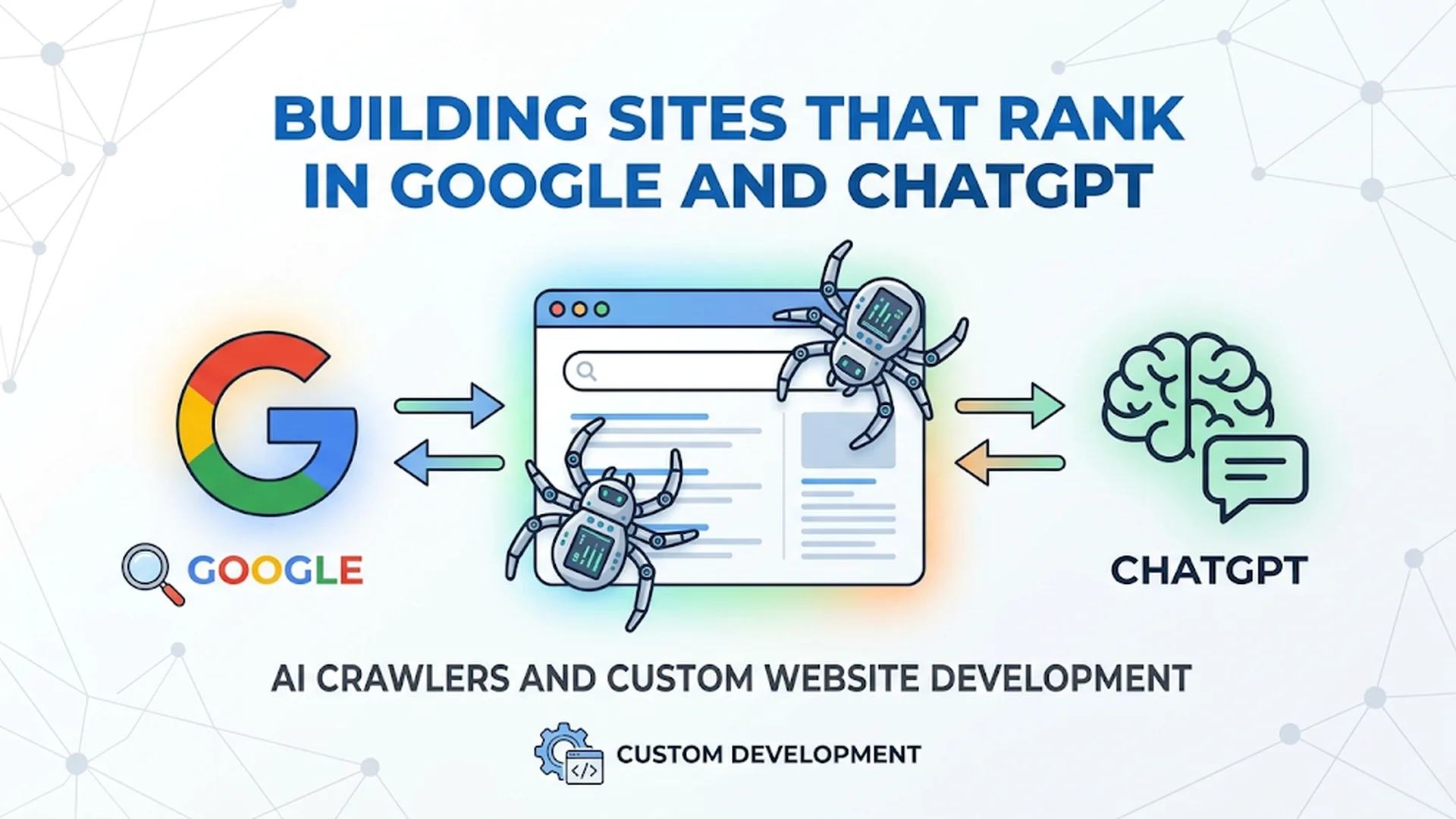
AI Crawlers and Reputation Management for Creators and Studios: Building Sites That Rank in Both Google and ChatGPT
- What makes a creator or studio site "AI-readable," in plain terms
- Why doesn't my React portfolio site show up in ChatGPT answers?
- The llms.txt file probably isn't doing what you think it's doing
- Schema markup helps content that already works. It doesn't rescue content that doesn't.
- Does my website design/development company need to build for AI crawlers specifically?
- Third-party trust still outweighs anything on your own domain
That gap is now one of the most expensive blind spots for anyone whose business runs on reputation. A YouTube editor, VFX artist, or small creative studio can sit at position one on Google for their own name, drive respectable traffic, and be completely unreadable to the crawler that feeds ChatGPT its answer about them. Not underperforming. Unreadable. The bot shows up, requests the page, and gets back an empty shell.
And that matters more every month. When a brand manager asks an AI assistant “Which motion design studios are good at product launch videos?” or a client types “Is [your studio] reliable?”, the answer they get is your reputation now. If the model can’t read your site, someone else’s site and someone else’s reviews get to tell your story.
Here’s what a creator or studio website actually needs to be legible to both systems, where the popular fixes fall short, and what that means for anyone hiring a website design/development company in 2026.
What makes a creator or studio site “AI-readable,” in plain terms
For creators and studios, this is where reputation quietly leaks. The details that make a client trust you (the brands you’ve cut spots for, the awards your reel picked up, your turnaround times, what you specialize in) are exactly the details that tend to live inside animated portfolio grids and JavaScript-driven case study pages.
That single sentence explains most of the AI-visibility problems creators and companies are currently paying agencies to diagnose.
Why doesn’t my React portfolio site show up in ChatGPT answers?
A joint analysis by Vercel and MERJ of more than 500 million GPTBot fetches found no evidence of JavaScript execution, even on pages where GPTBot downloaded the JavaScript files themselves. Independent testing quantifies how often that download happens without a run: GPTBot pulls JavaScript files in roughly 11.5% of its requests, and ClaudeBot in roughly 23.84%, and neither executes what it downloads. Vendor documentation confirms the same pattern across the entire AI-crawler set: GPTBot, OAI-SearchBot, ChatGPT-User, ClaudeBot, Claude-User, PerplexityBot, and Perplexity-User all fetch raw HTML and stop there.
Googlebot is the outlier, not the standard. It runs a full headless rendering engine, waits for content to mount, and indexes what actually displays. A single-page application built in React, Vue, or Angular can look complete to Google and be a blank <div id=”root”> to every AI system feeding ChatGPT, Claude, and Perplexity. A February 2026 crawl analysis quantified the gap: 42% of JavaScript-rendered content never gets indexed by AI systems at all.
Creative sites are especially exposed here. Portfolio sites lean heavily on scroll-triggered animation, autoplay showreels, filterable project grids, and page transitions, which is great for a human visitor and often a blank page for a bot. Your reel can be the best thing on the internet, but a crawler can’t watch video. It reads text, and if the text describing that work only exists after a script runs, the model has nothing to say about you.
So the test is not “does my site rank?” The test is: view source on your own page (not the rendered DOM in DevTools, the raw HTTP response) and look for your actual sentences. If your headline, services list, client names, or FAQ answers aren’t in that raw markup, an AI crawler gets nothing from that page, no matter how well it performs everywhere else.
For a creator or studio site, this is a build decision, not a content decision. Server-side rendering, static generation, or hybrid rendering that ships real content in the first response solves it. Keep the motion and the showreels, but make sure every project page also carries plain-text credits, a short description of the work, and the client or brand involved. A client-rendered SPA with no fallback does not solve it, no matter how good the work looks once it loads.
The llms.txt file probably isn’t doing what you think it’s doing
Originality.ai tracked more than three million domains and watched llms.txt adoption grow 8.8x in a year, from roughly 4,000 sites in June 2025 to over 36,000 by May 2026. That looks like momentum until you check whether anything is actually reading the file. Ahrefs pulled server logs across 137,000 domains and found that 97% of published llms.txt files received zero AI requests in May 2026. Not few. Zero. A separate SE Ranking study went further and ran an XGBoost model to test whether the file’s presence predicted citation frequency at all, and found that removing llms.txt from the model actually improved its predictive accuracy. The file added statistical noise, not signal.
That’s not an argument against publishing one. A well-built llms.txt costs almost nothing and does no harm. It’s an argument against treating it as a reputation strategy. Studios burning hours on llms.txt syntax while their case study pages still render blank to GPTBot have the priority order backward.
Schema markup helps content that already works. It doesn’t rescue content that doesn’t.
Ahrefs ran the cleanest test available: 1,885 pages that added JSON-LD schema between August 2025 and March 2026, matched against 4,000 control pages with comparable prior citation rates. Adding schema produced no statistically significant citation lift on Google AI Overviews, AI Mode, or ChatGPT. A separate academic study reached a compatible, more precise conclusion: generic schema types like Article, Organization, or BreadcrumbList showed no independent citation advantage, but Product and Review schema populated with concrete, extractable data (actual prices, actual ratings, actual specs) were cited at 61.7% versus 41.6% for pages without that attribute-rich markup. The effect was strongest on lower-authority domains trying to compensate for a weaker overall profile.
That last point is good news for independent creators and small studios. You don’t have the domain authority of a large agency, but you can publish concrete facts that a model can lift cleanly: a package price for a 30-second explainer, a verified client rating, the software you deliver in (After Effects, Premiere Pro, DaVinci Resolve), typical turnaround in days.
Read those two findings together, and the picture sharpens instead of contradicting itself. Schema is not a lever you pull to earn citations. It’s a format that helps a model extract a fact cleanly once the underlying content already has something worth extracting. Markup on a thin page stays thin. Markup on a page with real, specific, verifiable information gives a model less to interpret and more to lift directly.
Google also pulled the floor out from under one popular tactic in May 2026, announcing that FAQ rich results would stop appearing in Google Search entirely, with Search Console reporting and the Rich Results Test dropping support by that June. FAQPage schema still has a job to do for AI Overviews and structured extraction generally, but the specific rich-snippet payoff that made FAQ markup a checklist item for years is gone from Google’s own results.
Does my website design/development company need to build for AI crawlers specifically?
Most website design/development companies pitch to creators and studios and still sell against a Google-only checklist: page speed, mobile responsiveness, meta tags, a sitemap, and a showreel that autoplays nicely. None of that is wrong, and none of it is sufficient anymore. A site can pass every one of those checks and still be invisible to the crawlers currently answering a growing share of the questions clients and collaborators are asking about you. What to actually put in the scope of work:
- Server-rendered or statically generated markup: Real content in the first HTTP response, not content that only exists after a script runs. For a portfolio, that means every project page ships its title, client, role, tools used, and a written summary in plain HTML alongside the video. This is the single highest-leverage decision in the entire build, because nothing downstream fixes a page an AI crawler can’t read in the first place.
- A verified robots.txt policy for named AI agents: Roughly 84% of sites currently have no stated AI crawler policy at all, which means most creators and studios haven’t actually decided whether GPTBot and ClaudeBot are welcome. That should be a deliberate choice, documented in the build, not a default nobody looked at. If you want AI assistants recommending your studio, blocking them by accident is a reputation problem you’ll never see in Google Analytics.
- Attribute-rich structured data on pages where it’s earned: Product, Review, and FAQ schema with real prices, real ratings, and real specifics filled in, not boilerplate Organization markup applied uniformly across a site with nothing concrete to extract. Service packages, client testimonials with verifiable names, and deliverable specs are the creative-industry equivalents.
- A genuine answer to a real question on every page that competes for search intent: One header phrased the way a client would actually type it (“How much does a 60-second animated explainer cost?” or “Who edits videos for tech YouTube channels?”), followed by a direct, self-contained answer in the first few sentences. This is the pattern research on generative engine optimization keeps landing on regardless of platform: content structured to answer a specific question outperforms content structured to rank for a keyword.
- A crawl and render audit before launch, not after a client complains: Fetching the site with an AI crawler’s user agent and diffing what comes back against what a browser renders. Twenty-five percent of small business sites tested this way had at least one answer-critical element present in the rendered page but missing from the raw fetch the crawler actually receives.
None of that is exotic engineering. It’s a build checklist that most agencies haven’t updated since the last time “mobile-first” was the thing everyone had to relearn. And for studios already saving hours in production with ready-made templates and plugins, it’s worth putting a slice of that saved time back into making sure the work is actually visible.
Third-party trust still outweighs anything on your own domain
A Trustpilot analysis of more than 800,000 AI-generated responses across ChatGPT, Gemini, Perplexity, and Google AI Mode found that brands with no active review profile were cited in just 1% of answers. Brands that actively collected and responded to reviews were cited in 75.3% of answers on the same topics. Review and reputation sites accounted for 14% of all citations in that dataset, trailing only general brand websites as a source category.
That statistic sits uncomfortably next to the schema research above, and together they tell a consistent story. A model doesn’t just want your site to be readable. It wants independent confirmation that what your site says is true, and your own domain is structurally the weakest source for that confirmation, because it has an obvious conflict of interest. Your portfolio says you’re great. A model wants to see someone else say it.
For creative businesses, that independent record looks a little different from a retail brand’s. It’s client testimonials on Google Business Profile, Clutch, or Upwork. It’s verified profiles on Behance, Vimeo, and LinkedIn that match what your site claims. It’s festival selections, award listings, credits on IMDb, features on industry blogs, and a YouTube channel where comments and creator shout-outs back up your work. It also means responding to the occasional bad review or public complaint, calmly and on the record, instead of letting it sit as the only third-party opinion a model can find.
The technical build gets you into the pool of pages a model can even consider. Third-party validation (reviews, earned coverage, verified profiles) is what actually gets you cited once you’re in it. Firms like NetReputation increasingly treat those two workstreams as one project rather than two separate vendors, because a beautifully rendered portfolio with a thin or unmanaged review profile still loses the citation to a competitor with a worse site but a stronger reputation record.
The practical order of operations, then, isn’t “build the site, then think about AI later.” It’s: make the site legible to the crawlers that actually visit it, put real extractable facts in the markup where you’ve earned the right to claim them, and build the independent record that gives a model a reason to trust what the site says. Skip any one of the three, and the other two work at a discount.
Disclaimer : If you buy something through our links, we may earn an affiliate commission or have a sponsored relationship with the brand, at no cost to you. We recommend only products we genuinely like. Thank you so much.
Blog Label:



Write for us
Publish a Guest Post on Pixflow
Pixflow welcomes guest posts from brands, agencies, and fellow creators who want to contribute genuinely useful content.
Fill the Form ✏