When to Use Photography, Illustration, Animation, or Video in Your Marketing
- Choosing the Right Visual Format for the Message
- When Photography Is the Strongest Choice
- When Illustration Can Communicate What Photography Cannot
- When Animation Makes an Idea Easier to Follow
- When Live-Action Video Adds Something More
- Sometimes the Best Approach Uses More Than One Format
- Start With the Communication Goal
- The Best Format Is the One That Makes the Message Clearer
Choosing the Right Visual Format for the Message
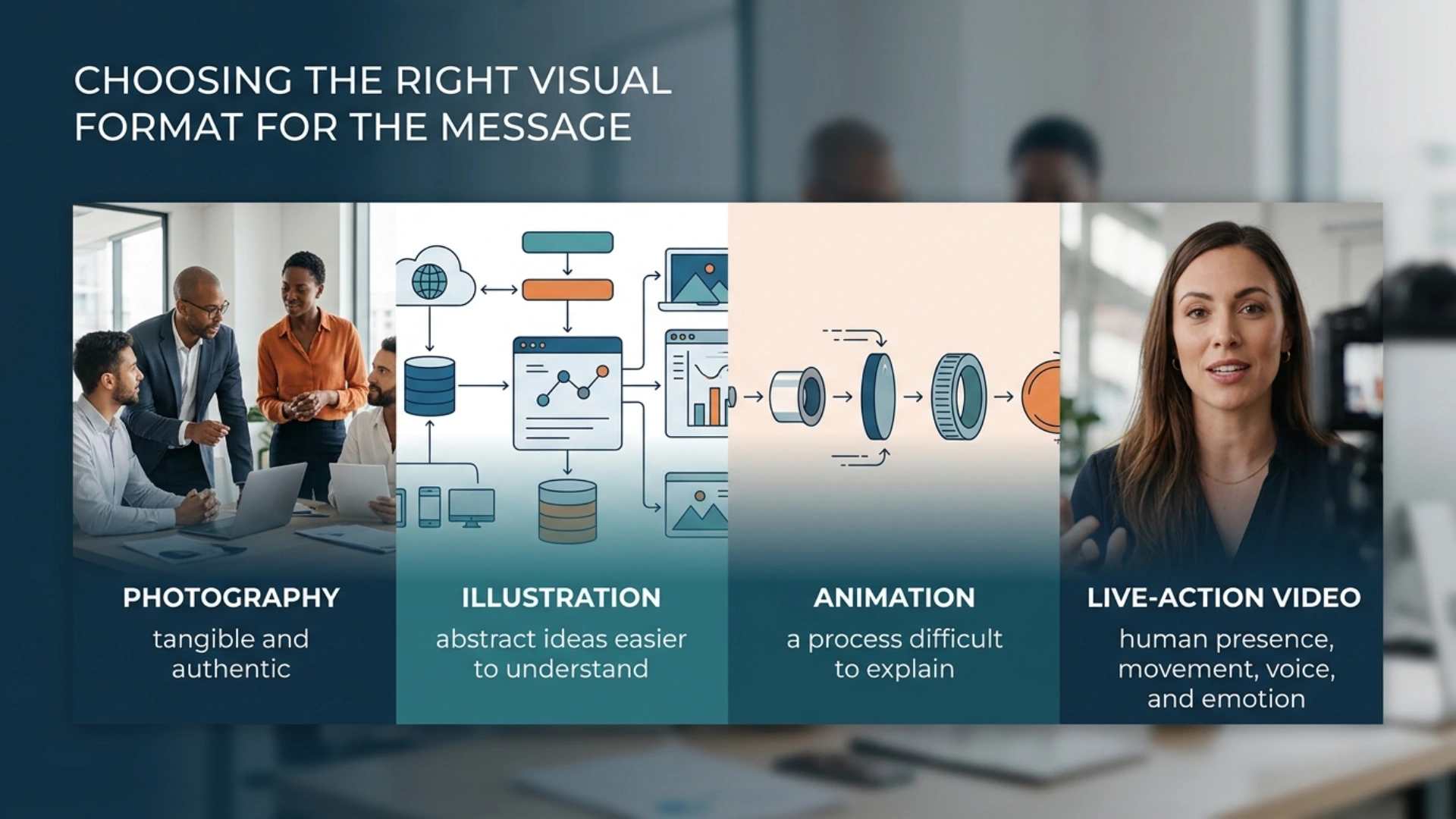
A photograph can make something feel tangible and authentic. Illustration can make an abstract idea easier to understand. Animation can show a process that would otherwise be difficult to explain, while live-action video can combine visuals, movement, voice, and emotion in a way that other formats cannot.
Instead of starting with the format, businesses can often make better creative decisions by starting with the purpose of the content.
When Photography Is the Strongest Choice
In these situations, photography does more than make a piece of marketing attractive. It provides information.
Real photographs can also create familiarity before someone ever interacts with a business. Seeing the team, location, products, or customers using a service can make an unfamiliar company feel more tangible. This can be especially useful when customers are making decisions where personal comfort or credibility matters.
Not every photograph needs to be produced specifically for a brand, however. Stock imagery can still work well for supporting visuals, backgrounds, or situations where the exact subject of the photograph is not important. Original photography becomes much more valuable when the people, environment, product, or experience itself helps someone evaluate the business.
The same decision frequently comes up when selecting imagery for a website. Businesses deciding how much custom photography they actually need can explore the differences between using stock photos and real photos for a business website and consider which images need to represent something specific to their organization.
The goal is not necessarily to eliminate stock photography. It is to recognize when authenticity is part of what the image is supposed to communicate.
When Illustration Can Communicate What Photography Cannot
Illustration provides far more freedom.
A technology company can visualize how information moves through a system. A financial company can represent an abstract concept without relying on another generic photograph of people sitting around a conference table. A healthcare organization can explain something occurring inside the body that would be difficult or inappropriate to show through photography.
Illustration can also give a brand much greater control over visual consistency. Colours, characters, proportions, perspective, and complexity can all be designed around an established visual system. That makes illustrations easier to adapt across campaigns while maintaining a recognizable look.
Guidance from The Open University similarly distinguishes between situations where authentic photography is valuable and those where illustration can provide the abstraction or creative flexibility required to communicate an idea.
That does not mean illustration should replace photography whenever something is complicated. The question is whether seeing reality adds useful information. If customers need to see the actual product, facility, team, or result, a photograph will usually communicate something an illustration cannot.
When Animation Makes an Idea Easier to Follow
This is where animation becomes particularly useful.
For example, a software company may want to show how information moves from one part of a platform to another. A service business might need to explain a multi-step process. A product company could show how several components interact without filming a physical demonstration.
Animation gives the creator control over exactly what the viewer sees and when they see it. Information can be introduced in sequence rather than presented all at once, which can make complicated subjects easier to follow.
It also allows marketers to visualize things that cannot easily be filmed. Data flows, internal processes, hypothetical situations, microscopic details, or conceptual relationships can all be represented visually without needing a physical scene.
However, movement by itself does not improve communication. An animation that constantly moves simply to attract attention can become distracting. Transitions, effects, and motion should help direct attention or explain what is happening.
A useful test is whether removing the movement would make the idea harder to understand. If the answer is no, animation may be adding production complexity without adding much value.
When Live-Action Video Adds Something More
Customer testimonials are a good example. A written testimonial can communicate what someone thought about a company, but video also communicates tone of voice, expression, and personality. The viewer gets additional information that would disappear if the same statement were presented as text.
The same applies to founder stories, employee introductions, interviews, product demonstrations, facility tours, and educational content involving an expert.
Live-action video can also help audiences understand experiences rather than just individual facts. A photograph of a hotel room shows what it looks like. A video can show someone entering the room, moving through the space, opening the balcony doors, and seeing the view. The viewer receives a much richer sense of what the experience might actually be like.
The trade-off is that live-action production can be less flexible than animation. Locations need to be arranged, people need to be available, equipment may be required, and changing part of the finished content can sometimes mean filming again.
That is why the choice between animation and live action should not simply come down to which format feels more impressive. If the message depends on real people, real products, or a real environment, live action has an advantage. If the goal is to construct an explanation that cannot easily be filmed, animation may be more effective.
Sometimes the Best Approach Uses More Than One Format
Some of the most useful creative work combines formats.
A live-action product demonstration might include animated labels highlighting individual features. A photograph could incorporate illustrated elements that explain something occurring outside the frame. An instructional video might alternate between a person speaking to the camera and animation that visualizes what they are describing.
The important distinction is that each format should have a job.
Mixing formats simply to make something more visually elaborate can create inconsistency. Combining them because each contributes information that the others cannot can make the final piece much clearer.
A broader visual system can also give marketers greater flexibility. Photography might be used whenever customers need to see the real organization, while illustration handles conceptual topics. Animation could explain processes, while live-action video is reserved for stories where people and personality matter.
That approach creates consistency without forcing every marketing message into the same creative format.
Start With the Communication Goal
A better starting point is to identify what needs to happen after someone sees the content.
If the audience needs to see something real, photography may be the simplest solution. If they need to understand something that cannot easily be photographed, illustration can provide more freedom. If they need to follow a sequence or understand how something changes, animation may make the process clearer. If personality, emotion, movement, and environment all contribute to the message, live-action video may provide the most complete experience.
The intended destination matters as well. A visual created for a large presentation has different demands than something appearing in a social feed, an advertisement, an email, or on a website. Thinking about where the creative will ultimately appear can prevent teams from producing something impressive that is difficult to use effectively.
The Best Format Is the One That Makes the Message Clearer
Photography brings audiences closer to something real. Illustration provides control and makes abstract concepts visible. Animation can show relationships and processes that are difficult to capture in a static image. Live-action video combines movement with the human qualities that audiences naturally respond to.
The strongest choice depends on what the audience needs from the content. When businesses begin with that question rather than the format they happen to prefer, creative decisions become easier to justify and the finished work is more likely to communicate something meaningful.
Disclaimer : If you buy something through our links, we may earn an affiliate commission or have a sponsored relationship with the brand, at no cost to you. We recommend only products we genuinely like. Thank you so much.
Blog Label:



Write for us
Publish a Guest Post on Pixflow
Pixflow welcomes guest posts from brands, agencies, and fellow creators who want to contribute genuinely useful content.
Fill the Form ✏