2026 Best AI Music Video Generators: How Ideas Turn Into Finished Songs and Videos in Minutes
- Introduction: Creativity Finally Got a “No Waiting” Mode
- The Old System: Creativity Hidden Behind Layers of Process
- Why 2026 Became the Breakout Year for AI Creative Tools
- From Text to Music: The New Way Sound Gets Created
- When Music Starts Designing Its Own Visual World
- The “Endless Version Loop” That Redefines Creation
- Who Is Actually Using AI Music Video Generators in 2026?
- The Shift From Technical Skill to Creative Direction
- Why This Is More Than a Productivity Upgrade
- Final Thoughts: Creativity No Longer Waits for Permission
Introduction: Creativity Finally Got a “No Waiting” Mode
Not a draft. Not a test clip. A complete audiovisual result that looks like it came from a professional production team.
But there was no team.
No filming, no editing timeline, no production meetings, no revision cycles that stretch for weeks.
Just a prompt → a finished result.
This is the core shift brought by AI music video generators. And the real transformation is not speed—it’s the removal of “waiting time” between imagination and creation.
Ideas no longer travel through production steps. They appear directly as finished outputs.
A typical workflow looked like this:
idea → songwriting → production → recording → mixing → visual planning → shooting → editing → revisions → approvals → final release
Each step introduced delay. Each delay reduced momentum. And each dependency increased the chance that the original creative spark would fade.
By the time the final product was completed, the idea often felt slightly disconnected from its origin.
Not because it was bad.
But because it had to survive too many steps before becoming real.
The biggest problem was never creativity.
It was friction.
Why 2026 Became the Breakout Year for AI Creative Tools
Three major forces drove this shift:
1. Content is no longer optional—it’s continuous
Creators are expected to produce constantly. If you stop, you disappear from recommendation systems.
2. Attention is extremely compressed
Users decide within seconds whether something is worth engaging with. Slow creation cannot survive fast consumption.
3. Production workflows became too complex
Too many tools. Too many steps. Too many coordination layers between idea and execution.
So AI didn’t add creativity.
It removed waiting from creativity.
And when waiting disappears, experimentation becomes the natural behavior.
From Text to Music: The New Way Sound Gets Created
An AI Song Generator allows users to turn simple text prompts into fully structured songs without needing instruments, production software, or musical training.
Instead of technical instructions, users describe emotion and atmosphere:
- “uplifting electronic track that feels like sunrise over a floating neon city”
- “soft indie pop with nostalgic emotional warmth and rainy-night memories”
- “cinematic ambient music for exploring abandoned futuristic worlds”
The system interprets these inputs and generates a complete composition—rhythm, melody, harmony, structure, and emotional tone included.
But the deeper shift is behavioral.
Users begin to think like directors instead of listeners. They test variations, compare outputs, and refine emotional direction through repetition.
Music creation becomes less about skill.
And more about expression.
When Music Starts Designing Its Own Visual World
So music naturally begins to demand visuals.
And AI systems respond immediately.
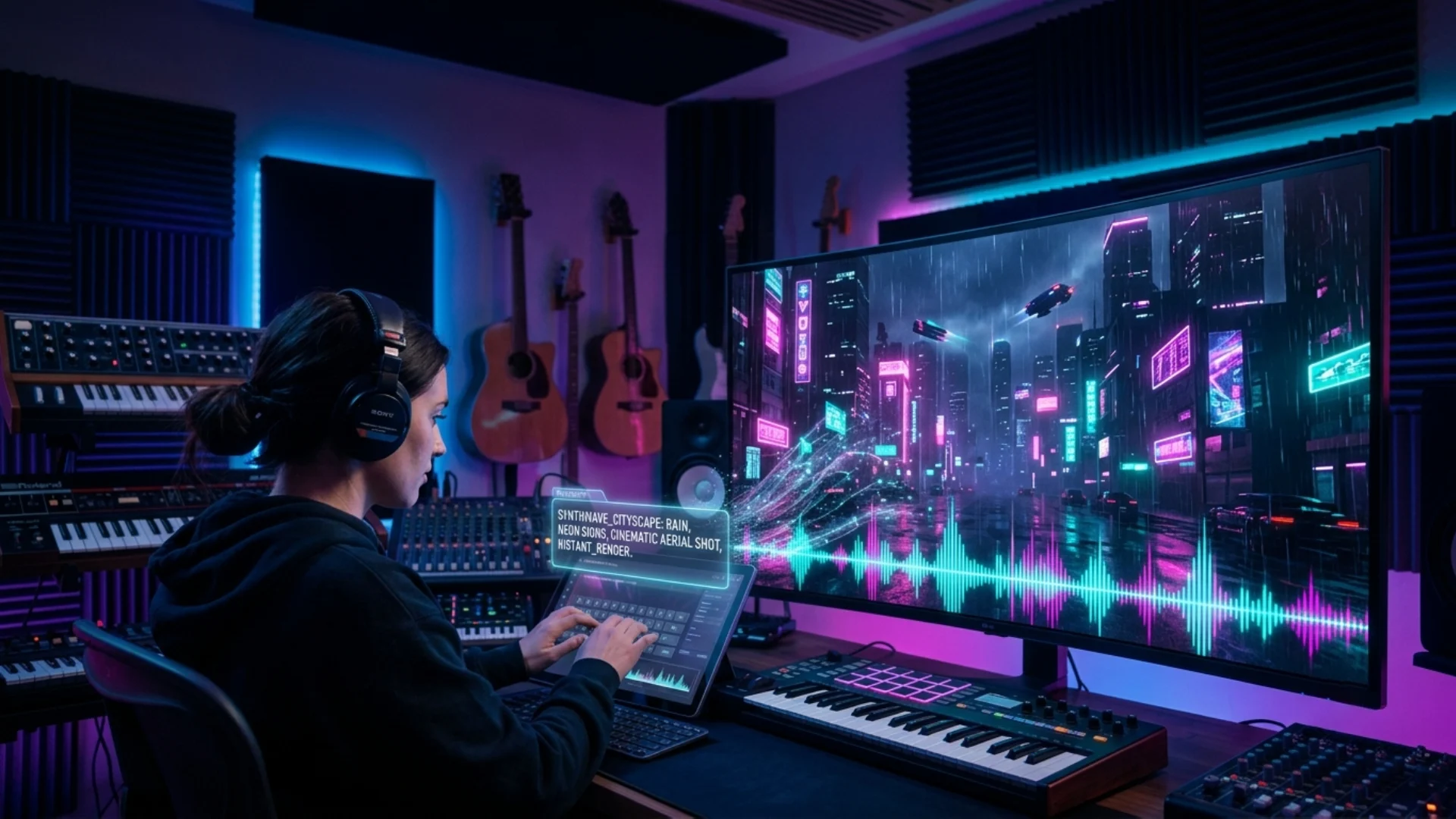
Instead of manually editing footage or searching for visual assets, creators allow algorithms to interpret sound as structured visual logic.
- rhythm becomes motion timing
- emotional tone becomes color palette
- intensity becomes camera movement
- structure becomes scene progression
This is where tools like the AI Music Video Generator become especially important.
They don’t simply add visuals to music.
They translate music into a visual system.
The result is not a video built around a song.
It is a video generated from the song itself.
The “Endless Version Loop” That Redefines Creation
You generate something → it looks good → you adjust one detail → you generate again → suddenly you’ve spent far more time than expected
This happens because AI removes the cost of iteration.
In traditional workflows, each version requires time, effort, and coordination. That naturally limits experimentation.
AI removes that limitation completely.
So the workflow becomes:
try → evaluate → adjust → try again → repeat
Because there is no penalty for exploring variations, users naturally explore far more than they intended.
And often, the strongest result doesn’t come from the first attempt—but from the middle of iteration.
Who Is Actually Using AI Music Video Generators in 2026?
- Independent musicians use them to quickly prototype songs
- Social media creators use them for fast content production
- Marketing teams generate campaign visuals on demand
- Indie developers build cinematic placeholders for projects
- Casual users experiment for fun and creativity
Across all these groups, one pattern is consistent:
when effort decreases, experimentation increases.
But more importantly, output becomes more diverse.
People don’t just create more content.
They explore more possibilities.
The Shift From Technical Skill to Creative Direction
That structure is now changing.
In AI-driven creation, advantage is shifting toward:
- speed of iteration
- ability to evaluate output
- clarity of creative direction
In other words:
It’s no longer about building.
It’s about guiding.
Creators move from operators of tools to directors of outcomes.
Why This Is More Than a Productivity Upgrade
In the old system, ideas had to survive friction to become real.
In the new system, ideas are instantly testable. They either evolve or disappear—but they are no longer blocked by delay.
This creates a new creative environment:
- more experimentation
- more variations
- more unfinished but explored ideas
- more unexpected directions
Creativity becomes less about commitment.
And more about discovery.
Final Thoughts: Creativity No Longer Waits for Permission
Creativity no longer waits.
The workflow is no longer:
idea → plan → execute → finish
It becomes:
idea → generate → evaluate → refine → repeat
Inside this loop, creativity stops behaving like a pipeline and starts behaving like a real-time system.
AI music and video generators do not replace creativity.
They remove the waiting period between imagination and execution.
And once that waiting period disappears, something becomes obvious:
people didn’t run out of ideas.
they finally stopped waiting for them to arrive.
Disclaimer : If you buy something through our links, we may earn an affiliate commission or have a sponsored relationship with the brand, at no cost to you. We recommend only products we genuinely like. Thank you so much.
Blog Label:



Write for us
Publish a Guest Post on Pixflow
Pixflow welcomes guest posts from brands, agencies, and fellow creators who want to contribute genuinely useful content.
Fill the Form ✏