Take Your Creativity To The Fast Lane

Explore Pixflow Video Template & Plugins ->

How Storytelling Found Its Way Into Casino Games
  • 28 Sep,2026
How Storytelling Found Its Way Into Casino Games
Saul Bass’s opening titles for The Man with the Golden Arm (1955) are a handful of white bars on black. They slide and stack to Elmer Bernstein’s score and finally snap into the jagged shape of an arm. Bass said he wanted a mood that was “spare, gaunt, with a driving intensity,” and he got it without a single actor on screen. Casino games have mostly told stories like that, with mood and a reveal and no characters at all. Characters came along later, and for a long time they were little more than cartoon hosts for the bonus round.

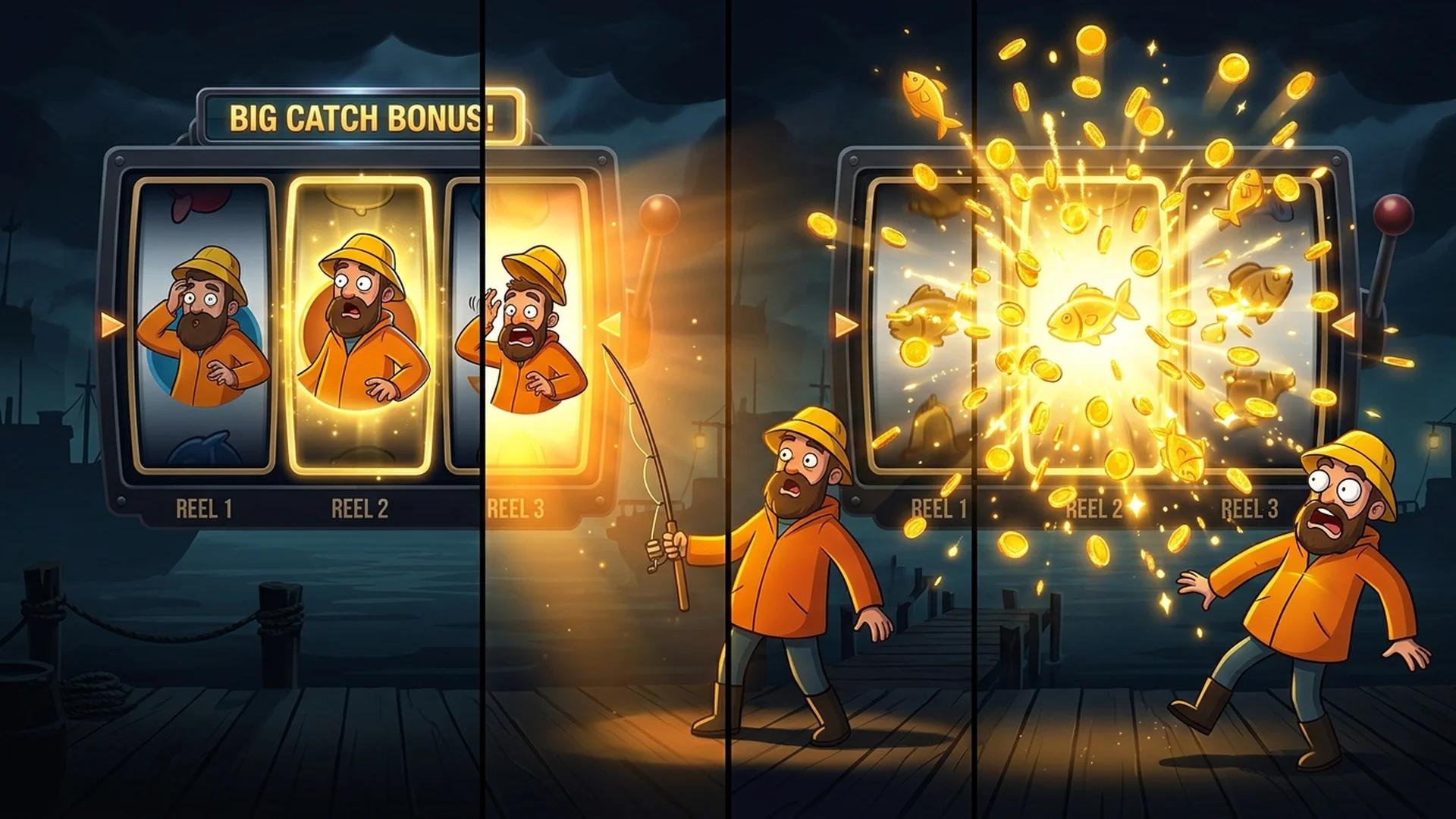
A fisherman in the second screen

Early slot machines had nothing you could call narrative. The theme lived on a painted glass panel and the reels were the whole show. That changed in the 1990s, when video slots started cutting away to a separate bonus scene. WMS’s Reel ‘Em In, from the late 1990s, was one of the earliest games built around that kind of second-screen bonus. Its cartoon anglers talked the player through the fishing sequence in thick Chicago accents (WMS was a Chicago company). The joke stuck, and a reboot called Super Reel ‘Em In turned up on Scientific Games’ Mural cabinet in 2021.

Where the story actually lives

When designing online casino games, most of the narrative lives in the transition states: an intro video that plays once at launch, a shift in lighting when a feature triggers, and a brief sequence moving in and out of a bonus round. Between those moments, the screen is just the reels and a looping background animation. The light change costs almost nothing to build and does more work than anything else in the game. Dim the background, warm up the reels, and the player knows something is different before any text appears. Most intros can also be skipped with a tap, which is a brief any title designer will recognize: get the mood across in the first couple of seconds or lose the audience.

That’s hard on whatever character the game has. It has to react to the same few events over and over without getting irritating, which is the brief animators usually get for a cereal-box mascot or a TV channel ident, not for a lead. Sketch a storyboard for one of those bonus sequences and it comes out short, five or six panels at most. Most of them end up as close-ups of the character: eyebrows up, mouth open, a double take as the bonus screen opens. The reward itself is usually a number counting up, which needs no drawing at all.

Particles, light and appeal

The effects came from film. When Bill Reeves, then at Lucasfilm, presented “particle systems” at SIGGRAPH in 1983, he described a way of drawing fuzzy things like “fire, clouds, and water” as swarms of tiny elements that are generated, move, change form and die. His paper grew out of the wall of fire in the Genesis sequence of Star Trek II. The spark showers and coin bursts on a modern slot are particle systems too, usually rendered live in a phone’s browser.

The characters owe more to Disney. Frank Thomas and Ollie Johnston, two of Disney’s Nine Old Men, wrote The Illusion of Life (1981), which lists appeal among the studio’s twelve principles of animation, the quality that makes an audience want to keep watching a character, villains included. A figure who’ll be seen thousands of times needs appeal more than any single clever animation, so most slot characters get broad silhouettes and faces you can read at thumbnail size.

Characters who keep coming back

The newer idea is bringing characters back: the same explorer, or the same vampire family, across several releases. A few games also hold scenes back and release them as you progress, the way a series drops chapters. A slot character who returns for a sequel is basically a mascot. The costume and the voice come back, and nothing that happened last time carries over. Those unlockable scenes are a retention feature with story art on top, and motion designers asked to build one should know that going in.

Disclaimer : If you buy something through our links, we may earn an affiliate commission or have a sponsored relationship with the brand, at no cost to you. We recommend only products we genuinely like. Thank you so much.

Blog Label:

Write for us

Publish a Guest Post on Pixflow

Pixflow welcomes guest posts from brands, agencies, and fellow creators who want to contribute genuinely useful content.

Fill the Form ✏