Practical Effects vs CGI: Which Ages Better and Why It Matters
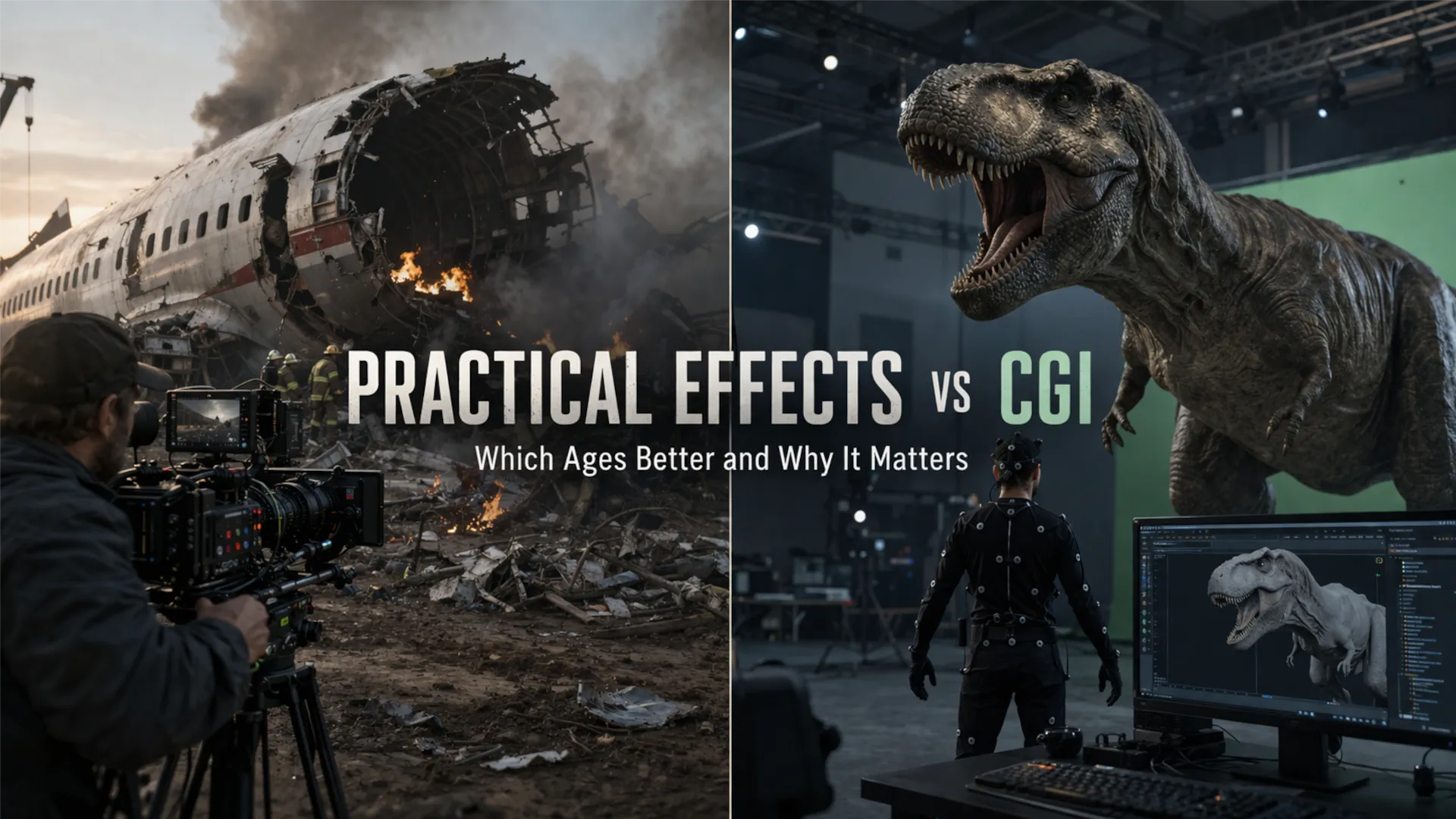
- What Are Practical Effects and CGI
- Why Practical Effects Stand the Test of Time
- When CGI Ages Gracefully
- The Science Behind Why Our Eyes Trust Practical Effects
- Christopher Nolan - The Master of Practical-First Filmmaking
- The Hybrid Approach - Why the Best Modern Films Use Both
- Why This Debate Matters for Creators of Today
- Conclusion
Here’s the thing: not all special effects are created equal, and more importantly, they don’t all age the same way. The debate between practical effects vs CGI has been raging for decades, but the real question isn’t which is “better.” It’s which one stands the test of time, and why that should matter to anyone who makes or loves films.
In this breakdown, we’re diving deep into the longevity of both approaches, packed with film examples from The Thing to Oppenheimer, to understand what makes visual effects age gracefully or fall apart.
What Are Practical Effects and CGI?
Both approaches serve the same goal: making audiences believe in something that isn’t real. But the way they achieve that goal, and how that achievement holds up over time, differs dramatically. If you want a more detailed breakdown of the technical differences, check out our guide on VFX vs. CGI vs. SFX and how they revolutionize filmmaking.
Why Practical Effects Stand the Test of Time
Take John Carpenter’s The Thing (1982). Rob Bottin’s creature effects are grotesque, visceral, and absolutely convincing over 40 years later. The rubber, latex, and mechanical components interact with the set, the actors, and the lighting in ways that feel organic. No rendering engine can perfectly replicate the way a practical creature moves under on-set fluorescent lights.
Or consider Ridley Scott’s Alien (1979). H.R. Giger’s Xenomorph design, brought to life through suits and mechanical puppetry, remains one of cinema’s most terrifying creations. The reason? You’re looking at something that physically exists, photographed with real cameras, under real lighting conditions.
As No Film School points out, “most CGI from 10 years ago often looks worse than practical effects from 40 years ago. Technology moves that fast.” That’s a powerful observation. Practical effects don’t degrade as display technology improves. A practical puppet filmed in 1982 looks the same whether you’re watching on a CRT television or a modern OLED display.
Rick Baker’s transformation sequence in An American Werewolf in London (1981) is another standout. The detailed prosthetic work won the first-ever Academy Award for Best Makeup, and it still looks stunning today. And Stanley Kubrick’s 2001: A Space Odyssey (1968) used massive rotating sets, slit-scan photography, and detailed miniatures to create visuals that critics agree no other film matched for nearly two decades.
When CGI Ages Gracefully (and When It Doesn’t)
CGI That Still Holds Up
Terminator 2: Judgment Day (1991) is perhaps the best example. James Cameron’s liquid-metal T-1000 relied on a relatively simple visual concept: reflective chrome surfaces. Because the effect wasn’t trying to replicate organic textures or complex skin, it still looks clean and believable today.
Steven Spielberg’s Jurassic Park (1993) is the gold standard for a reason. Spielberg used CGI sparingly (roughly 6 minutes of CGI in the entire film), combining it with Stan Winston’s full-scale animatronic dinosaurs. The result? A film that holds up over 30 years later because the CGI enhanced practical work rather than replacing it.
Peter Jackson’s Gollum in The Lord of the Rings: The Two Towers (2002) pushed motion capture into the mainstream. Andy Serkis’s performance gave the digital character an emotional depth that makes the slightly dated rendering forgivable. And the Wachowskis’ The Matrix (1999) pioneered bullet time with a blend of practical camera rigs and digital compositing that remains iconic.
CGI That Hasn’t Aged Well
Then there’s The Mummy Returns (2001). The fully CGI Scorpion King, featuring a digital version of Dwayne Johnson, has become one of cinema’s most infamous examples of effects that crumbled with time. As PremiumBeat explains, “Technology will always quickly date itself. But, taking the time to carefully compose and create your effects with a focus on lighting, composition, and even colors can help you create visuals that don’t just look like flashy effects, but actually aid in the story.” The Scorpion King did none of those things, and it shows.
George Lucas’s Star Wars prequels (1999-2005) present another cautionary tale. The original trilogy’s practical miniatures and puppets remain beloved. But the prequels’ heavy reliance on early CGI environments left actors struggling against empty green screens, and the digital creatures from that era look increasingly artificial with each passing year.
Green Lantern (2011) is a strong example of how even relatively modern CGI can look cartoony when overused. Ryan Reynolds’ entire suit was CGI, and the results were widely criticized. Spawn (1997) featured hell sequences with CGI that looked dated almost immediately upon release. And The Polar Express (2004) dove straight into the uncanny valley with its motion-captured human characters, producing a film that still unsettles audiences for all the wrong reasons.
The Science Behind Why Our Eyes Trust Practical Effects
CGI, no matter how advanced, is an approximation of reality. And our brains notice the gap, even when we can’t consciously identify what’s “off.” This is closely related to the uncanny valley effect: the closer something artificial gets to looking real without quite reaching it, the more unsettling it becomes. It’s why a slightly unrealistic rubber monster feels charming, while a nearly-perfect digital human feels creepy.
As The Los Angeles Film School explains, “Using practical effects instead of CGI makes it easier for actors to interact with their surroundings, allowing for the creation of scenes and sequences that are more realistic.” When actors can physically see and touch what they’re reacting to, their performances carry more authenticity, and audiences pick up on that.
One Reddit discussion on r/movies captures this sentiment perfectly: users consistently note that even “bad” practical effects tend to be endearing, while bad CGI is just distracting. There’s something forgivable about a physical object that doesn’t quite look right, and something jarring about a digital one that doesn’t.
Christopher Nolan: The Master of Practical-First Filmmaking
In The Dark Knight (2008), Nolan famously flipped an actual 18-wheel semi truck on a Chicago street. No CGI. That moment has a visceral impact that would be nearly impossible to replicate digitally because your brain registers the real weight, momentum, and physics of a massive vehicle tumbling end over end.
Inception (2010) took things further with its iconic rotating hallway fight scene. Rather than using CGI to simulate zero gravity, Nolan built a massive rotating set and had actors physically fight while the world spun around them. The result is one of the most memorable action sequences of the last two decades.
For Interstellar (2014), Nolan worked with theoretical physicist Kip Thorne to create the black hole Gargantua. While the visualization involved heavy computation, the film’s practical sets for the spacecraft interiors grounded the cosmic spectacle in tangible reality. The cornfield? Nolan grew 500 acres of real corn for the shoot.
And then there’s Oppenheimer (2023). As the Berkeley High Jacket reports, Nolan said he chose not to use computer graphics because it “tends to feel safe.” He recreated the Trinity nuclear test using a combination of practical pyrotechnics, forced perspective, and IMAX cameras. The sequence is breathtaking precisely because it feels dangerous and real.
Nolan’s philosophy isn’t anti-CGI. It’s about using CGI as a tool to support practical work, not as a replacement for it. And when you compare how his films age against CGI-heavy blockbusters from the same era, the difference is striking.
The Hybrid Approach: Why the Best Modern Films Use Both
George Miller’s Mad Max: Fury Road (2015) is the definitive example. As No Film School details, Miller used over 150 real vehicles, real explosions, and real stunt performers, then layered CGI on top to enhance skies, remove safety equipment, and extend environments. The film looks as spectacular today as it did on release.
Denis Villeneuve’s Dune (2021) followed a similar philosophy: massive practical sets, real desert locations in Jordan, physical costumes, and detailed miniatures, with CGI handling the sandworms and larger-than-life elements. The combination creates a visual texture that feels solid and lived-in.
As AAFT notes in their analysis, “CGI and practical effects often occur together in movies. While the former uses computer-generated images, layering them with live-action footage, the latter uses wireworks, harnesses, weather effects, and makeup and prosthetics on sets to add a sense of hyper-realism.”
This hybrid approach addresses the core aging problem: the practical foundation gives your effects a permanent anchor in reality, while CGI handles what’s physically impossible. When the digital work eventually looks dated (and it will), the practical elements underneath keep the scene from falling apart.
Why This Debate Matters for Today’s Creators
The principles behind the practical effects vs CGI debate apply to every level of video production. Understanding how light, texture, and physicality create believable visuals makes you a better editor, a better colorist, and a better storyteller.
If you’re working in post-production, knowing when to use practical elements, like real film frame overlays and analog textures, versus purely digital effects can dramatically improve the perceived quality of your work. A stock overlay that mimics real film grain will always look more authentic than a digitally generated approximation, for the same neurological reasons we’ve been discussing.
The same principle applies to color grading. The most effective cinematic color grades draw from the organic imperfections of real film stock, not from cranking digital saturation sliders. Working with tools that emulate real-world characteristics, like Pixflow’s Letterbox Film Frame Templates, gives your projects a grounded, cinematic quality that pure digital effects struggle to match.
Whether you’re building a cinematic look for your next project or diving into motion tracking in After Effects, the lesson from Hollywood’s effects history is clear: start with something real, then enhance digitally.
Conclusion
Films like The Thing, Jurassic Park, and Mad Max: Fury Road prove that practical craftsmanship can look stunning for decades. Meanwhile, the CGI Scorpion King and Green Lantern serve as reminders of what happens when digital effects outpace the artistry driving them.
For creators at any level, the takeaway is the same: ground your work in authenticity. Use real textures, practical overlays, and tools rooted in cinematic tradition whenever possible. Then let digital tools enhance, not replace, that foundation.
The effects that age the best are the ones that were real to begin with. That’s a lesson worth remembering every time you sit down to edit.
Disclaimer : If you buy something through our links, we may earn an affiliate commission or have a sponsored relationship with the brand, at no cost to you. We recommend only products we genuinely like. Thank you so much.
Blog Label:



Write for us
Publish a Guest Post on Pixflow
Pixflow welcomes guest posts from brands, agencies, and fellow creators who want to contribute genuinely useful content.
Fill the Form ✏